
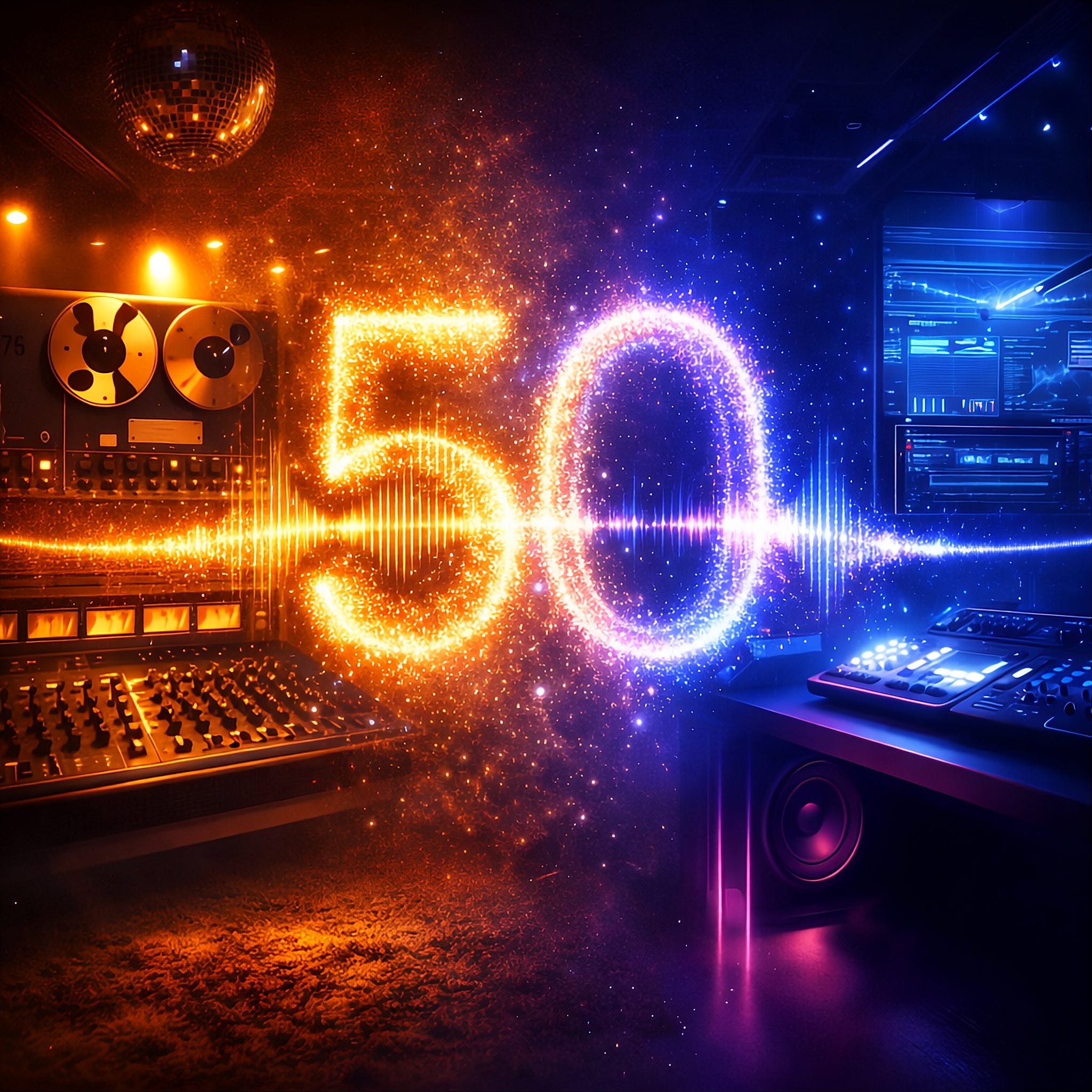
1976 Meets 2026
Fifty Years Later…

AI Gen Process/Software: Human, ChatGPT, Producer.ai – DAW: Audacity 3.7.7, OS: Linux (Ubuntu 25.10)
1976 Meets 2026 – Full Album (3:13:17)
Stream/Download Free MP3:
If you were anywhere near a radio in 1976, you remember it. All of it. You remember the sweep of melody, the tasty hooks, the way pop music that year seemed to exist in Technicolor. It was a year when AM radio still ruled the dashboard, when FM was still stretching its wings, and when genres did not stay in their lanes. Disco flirted with rock. La música latina continuó su ascenso meteórico. Soul brushed up against soft pop. Television themes escaped their shows and landed on the charts like they owned the joint.
In 1976, songs were events. You had the craftsmanship of Paul McCartney on Silly Love Songs. The operatic audacity of Bohemian Rhapsody by Queen still dominating the cultural air. The orchestral disco pulse of A Fifth of Beethoven. The velvet cool of Boz Scaggs on Lowdown. The pristine ache of All By Myself. The euphoric propulsion of You Should Be Dancing by Bee Gees.
It was melodic abundance. It was harmonic ambition. It was rhythm you could dance to, Jazzercise to, rollerskate to, cry your eyes out to, absorb with a select group of “altered” friends in the basement, or just keep you company on a long drive or alone with a good set of headphones. 1976 felt like a hinge year. The innocence of early seventies singer-songwriter warmth was still present, but the future was sure knocking.
Synthesizers were no longer curiosities. Studio production was becoming architecture. Dance floors were evolving into test labs. Television themes like Theme from The Rockford Files proved that even instrumental music could become mainstream muzak.
Fifty years later, we live in a different sonic universe. The low end is deeper. The stereo field is wider. The kick drum hits like a heartbeat in various forms of surround sound. Production is sculpted for headphones, clubs, cars, and streaming algorithms, all at once.
So the question became obvious to me.
What happens if we keep the soul of 1976 but give it the body of 2026?
That is the heart of this project. I did not want to erase the past. I wanted to reframe it. The original lead vocals remain sacred (mostly). Timing, phrasing, breath, humanity. Those performances are time capsules, and I didn’t tamper with their emotional DNA. Instead, I re-regulated the nervous system around them.
Imagine Play That Funky Music stepping into a modern club with sub bass that rattles rib-cages. Imagine Dream Weaver floating through contemporary atmospheric synths and VSTs. Imagine September by Earth, Wind & Fire reintroduced with pristine transient shaping and a low end engineered for today’s dance floors. Imagine the TV themes of Charlie’s Angels or Happy Days reborn as festival ready anthems.
The melodies stay. The keys stay. The grooves stay. The spirit absolutely stays. But the instrumentation evolves. Deep, tight sub bass replaces thin seventies low end. Drums are layered and sculpted. Guitars get a modern funk polish. Strings and horns are revoiced with contemporary clarity. The mixes breathe in full stereo width. The mastering speaks fluent streaming.
This is not nostalgia for nostalgia’s sake. This is a conversation across fifty years.
1976 was a year when pop music was still fearless. It was not afraid to be catchy, ambitious, romantic, theatrical, or just fucking beautifully strange (see Frank Zappa). Updating these songs to a 2026 sonic language felt right because great songwriting survives translation. A strong melody is immortal. A compelling vocal performance transcends production eras and trends.
These fifty tracks are my way of standing at that crossroads, one foot on shag carpet, one foot on an LED dance floor. If you lived through 1976, I hope this record feels like memory with a new pulse running through it. If you did not, I hope it feels like discovery. Either way, I invite you to listen not just for what changed, but for what never had to.
Turn it up.
Let 1976 meet 2026.
P.S. My fellow audiophiles will quickly realize that most of the songs are from 1976, but some are from elsewhere in the 1970s, and a couple precede and follow the decade.
Why? Because I can.
Music Prompt:
Set the variation and cover strength to 80% and generate a 2026 cover of the uploaded song. Do NOT replace the vocals.
Rebuild the entire instrumental production in a modern 2026 Electronic Dance Music/Techno/Club sonic style. If the song has guitars, add funky 2026 versions. If there are any horns or strings, update those as well.
Use contemporary production techniques:
• Clean, wide stereo imaging
• Deep, tight low-end with modern sub-bass design
• Punchy, layered drums with crisp transient shaping
• Textural synth layers and atmospheric depth
• Modern chord voicings and rhythmic movement
• Streaming-ready loudness and clarity
The final result should feel like a high-budget 2026 studio production built around the preserved original vocals, a remix via full modernization.
Tracklist
Download Free Individual MP3s/.M3U Playlist: 76-26.zip (218.4 MB)
I adore this! Soooo good! Amazing!
Is it really 50 years later? I can't wait to listen to this. I was always dancing in the discos to many of these tunes. Actually, I will play this now. Thanks for the memories.