
AEO Best Practices
Stop Writing for Google. Start Writing for AI That Answers Instead.

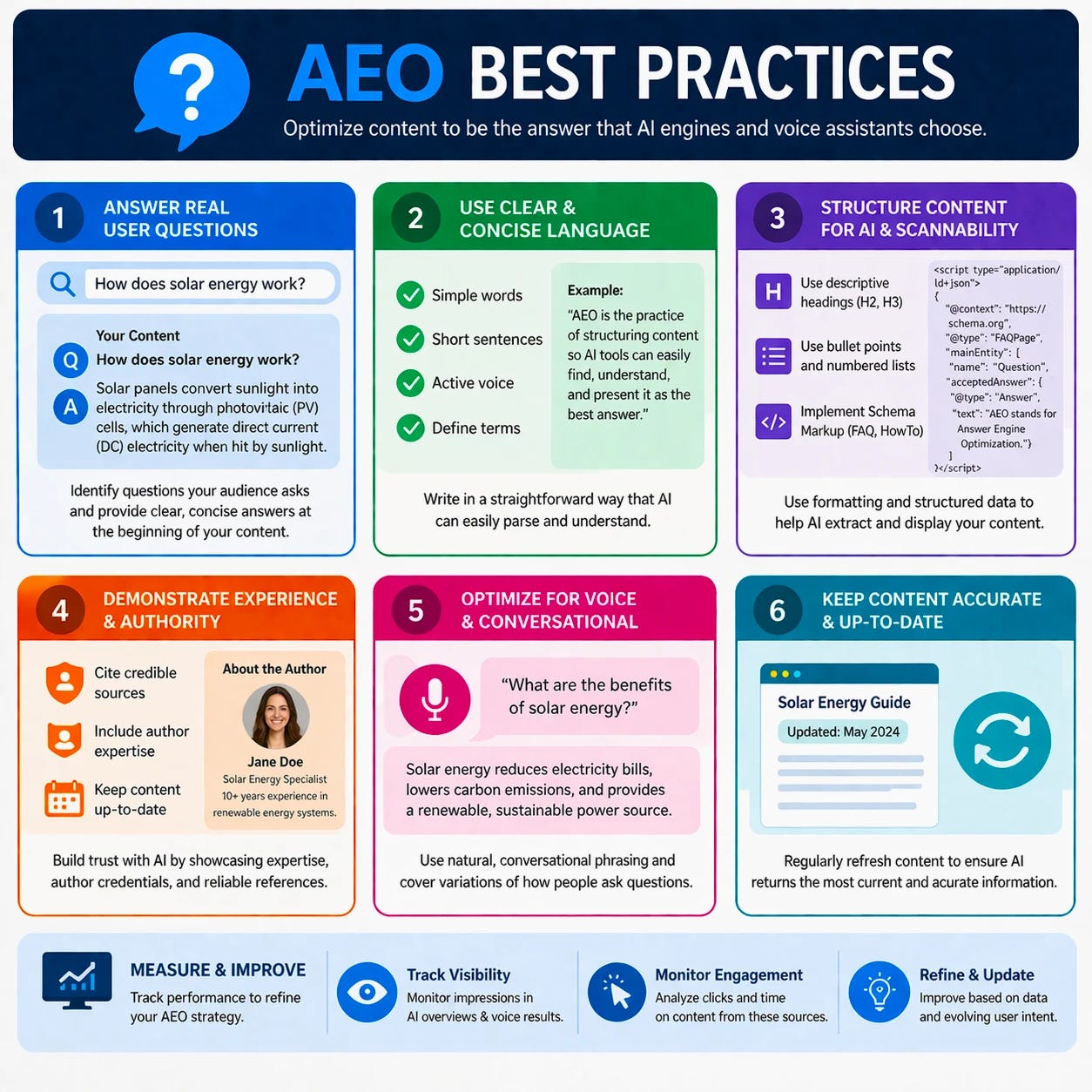
The shift from search engines to answer engines is already here. If your content isn’t built to be quoted, it will slowly disappear without ever knowing why.
I’m going to say this plainly, because this demands plain speech.
Search has changed.
Not cosmetically. Not incrementally.
Fundamentally.
For twenty years, we wrote content to rank. We chased keywords, back-links, and page position. We treated Google like a scoreboard. Today, people ask a question and receive a synthesized answer. No scrolling. No ten blue links. Just a response, delivered with confidence. And if your organization, project, or idea is not structured to be cited in that response, you are effectively invisible.
This is where Answer Engine Optimization (AEO) enters the conversation. Not as hype. Not as a rebrand. But as an adaptation to a new reality.
According to recent industry guidance, AEO is the practice of structuring content so AI systems can easily understand it and deliver it as the direct answer to a user’s question across tools like voice assistants and AI search interfaces. Google Search structured data guidance (Blockchain Council)
In other words:
SEO gets you found.
AEO gets you quoted.
And quoting is the new currency.
The First Rule of AEO: Answer the Question Immediately
Most websites bury the answer three paragraphs down. That worked when humans were scanning pages. It does not work when machines are extracting sentences. Modern search systems often pull a single response from the top of a page. If the answer is delayed, the system simply moves on. (TapClicks)
So the discipline is simple:
Lead with the answer.
Then explain it.
Not because readers are impatient, but because machines are literal. They do not interpret intent. They extract clarity.
The Second Rule: Structure Is Not Decoration. It Is Infrastructure.
We used to think formatting was about aesthetics. Now it is about survival. Research into AI citation behavior shows that structured elements like metadata, semantic HTML, and freshness signals strongly correlate with whether a page gets cited in AI-generated answers. (arXiv)
That means:
Headings matter.
Lists matter.
Definitions matter.
Consistency matters.
Not for style. For visibility. If your content looks like a wall of text, machines see fog. If your content is organized, machines see coordinates.
The Third Rule: Use Structured Data, or Accept Reduced Visibility
This is the part many people skip because it feels technical.
Don’t skip it.
Structured data, often implemented through Schema.org markup, provides machine-readable context that helps AI systems interpret what your content actually represents. (FoxAdvert) Without that layer, even high-quality content can be overlooked.
Think of it this way. Your article is a book. Structured data is the library catalog. Both matter. Only one gets you shelved correctly.
If you run an organization, nonprofit, school, or initiative, the most important schema types are:
Organization
Article
FAQ
Event
HowTo
These are not optional anymore. They are table stakes.
The Fourth Rule: Write Like a Human Speaks
This is not about dumbing things down. It is about matching how people actually ask questions. Users are increasingly searching in full sentences and conversational language, especially through voice assistants and AI tools. (Blockchain Council)
So instead of writing:
“asylum housing eligibility criteria”
Write:
How can an organization legally provide housing for asylum seekers?
That difference is not stylistic.
It is functional.
The Fifth Rule: Authority Is Earned Outside Your Website
This one surprises people. You cannot simply declare yourself credible. Answer engines look for signals across the web, not just on your own pages. Studies have found that sources with recognized profiles or external references are significantly more likely to be cited in AI-generated answers. (Articsledge)
That means:
Mentions matter.
Citations matter.
Partnerships matter.
Reputation matters.
The web is now a reputation network. Your site is only one node in that network.
The Sixth Rule: Update Content Relentlessly
Freshness is not vanity. It is a signal. AI systems weigh recency heavily, especially for topics involving policy, technology, funding, or regulation. (Articsledge)
If a page sits untouched for years, machines assume it is stale.
And stale information is rarely quoted.
The Seventh Rule: Build Topic Clusters, Not Isolated Articles
One article is a voice. A network of articles is authority. Answer engines evaluate whether a source covers a topic comprehensively. Pages that form a connected body of knowledge signal expertise and reliability. (Articsledge)
So instead of writing a single post about a subject, build a series:
What it is
Why it matters
How it works
Legal considerations
Funding models
Case studies
That structure turns a blog into a library. And libraries get cited.
The Eighth Rule: Clarity Beats Cleverness
This is the hardest lesson for writers. We love elegance. We love voice. We love metaphor.
Machines love precision.
Short sentences are easier to extract.
Direct definitions are easier to quote.
Specific facts are easier to trust.
The goal is not to impress the reader.
The goal is to be reusable.
What This Means for Anyone Building Something That Matters
Whether you’re running a school, a nonprofit, a community initiative, or a digital platform, the implications are the same. Visibility is no longer about traffic. It is about presence in answers.
If someone asks:
“How do community-based learning networks work?”
“How can a nonprofit provide housing legally?”
“What is a project-based education model?”
Your organization should be the response that appears. Not because you gamed the system. Because you explained the truth clearly.
The Very Best Practice
Here is the part no consultant will put in a slide deck.
Write things worth quoting.
Not filler.
Not jargon.
Not marketing noise.
Just clear, honest, structured knowledge. Because in the age of answer engines, the Internet is becoming less like a marketplace and more like a reference book.
And reference books remember the authors who speak plainly.
Authoritative Sources Worth Reading
If you want to go deeper, start here:
These are not marketing blogs. They are the technical scaffolding behind how visibility works now.