
Azadi
Retaking the Soul of Persia with the Roar of Lions

AI Gen Process/Software: Human, ChatGPT, Perchance.org, Producer.ai – DAW: Audacity 3.7.7, OS: Linux (Ubuntu 25.10)
More to the Story: https://tatanka.site/azadi
“azadi” Full Album (2:33:24)
FREE Download: MP3 (128 kbps – 140 MB)
The embedded 6.3 Hz Binaural Beat is relatively loud in the mix, to maximize its benefits for intended listeners, Persians everywhere.
Late in December 2025, a spark lit across the bazaars, universities, and neighborhoods of Iran and transformed into a blaze of defiance that now engulfs every province. What began as protest over crushing economic collapse and unendurable cost of living has grown into a nationwide cry for dignity, justice, and fundamental human rights.
This is not a protest contained to a single city. This is a movement, unstoppable in its breadth, interwoven with the scars, hopes, and songs of the Persian people themselves.
The regime’s latest reaction has been to do what it has done before when faced with its own people’s soul, to cut off the airwaves. On January 8, as Iran entered its twelfth day of mass demonstrations, Iran’s authorities imposed a near-total Internet blackout, reducing connectivity to only a trickle. The aim was clear, to cut the voice of the people from the eyes and ears of the world and hide the regime’s violent response to dissent.
But an Internet shutdown can only dim the screen. It cannot extinguish the signal of resolve.
Why Cutting the Internet Will Fail
No regime in history has successfully starved a people of communication and simultaneously starved their desire for liberty. The Internet blackout is a mere tactical reflex of the theocratic state, but it is not a strategic solution to the historic problems. Past protests have shown that such measures spark adaptation, satellite links (this is Elon Musk’s chance to convince the world of his rumored humanity and simply switch on Starlink), VPNs, and offline mesh networks, today’s technologies that can become tomorrow’s lifelines. Ironically, the regime’s attempt to muzzle voices abroad only sharpens them, as families abroad amplify every flicker of news they can collect, and the diaspora becomes a chorus in support of those on the ground.
The people of Iran are not behind walls. They are woven into the global community, and every disruption simply invites the world to listen harder. People inside Iran still risk everything to send fragments of videos and encrypted messages, refusing to let their reality be buried by the regime’s digital censorship.
Even in darkness, people signal.
The Color Red Isn’t Just Dye — It’s Declaration
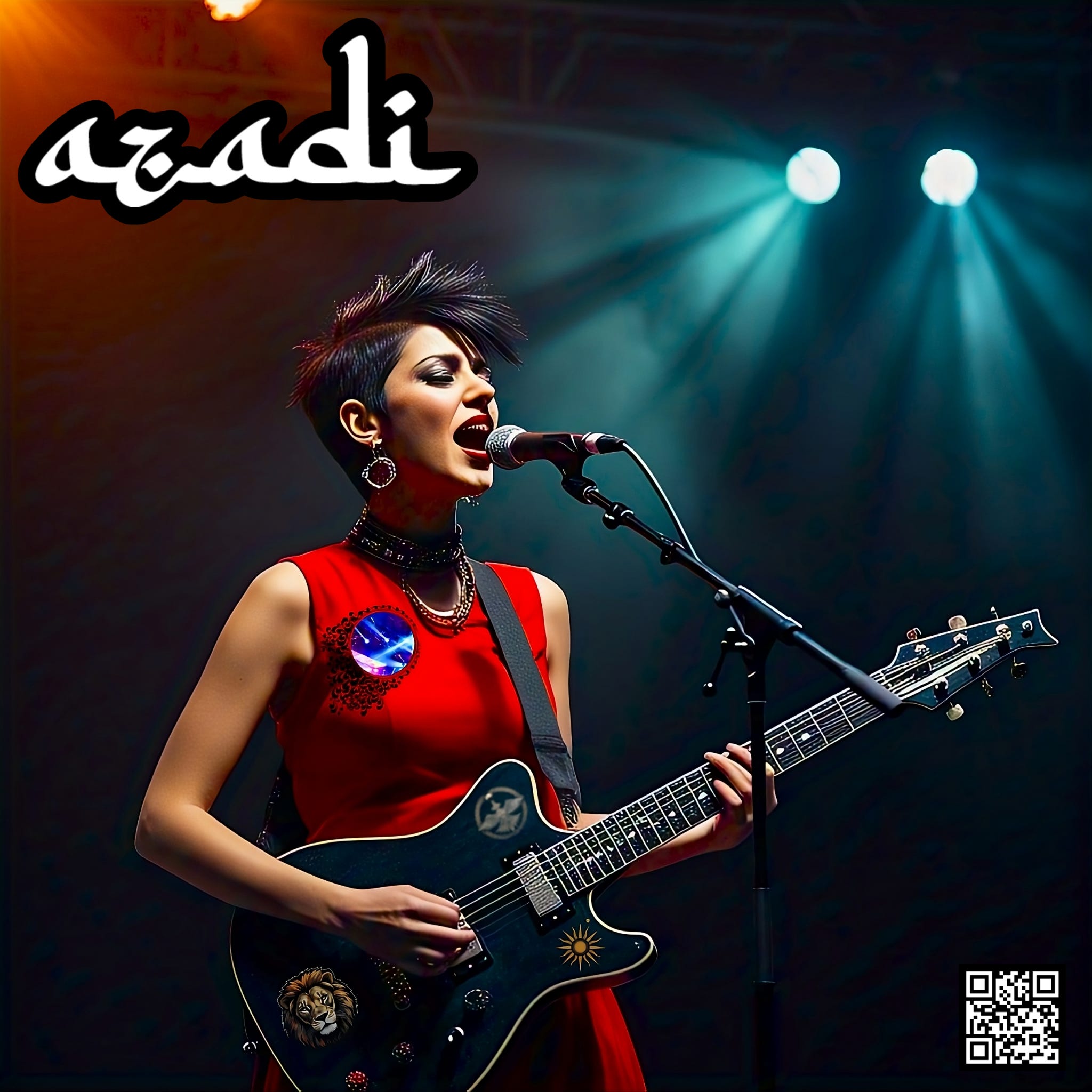
The artwork I shared above is from my original project from June 2025, the cover image of a woman in vibrant red, guitar raised, hair defiant. It is not abstract art. It is indictment and promise. Her punk ethos is the unburied voice of every silenced woman and man inside Iran. The guitar, marked with emblems of struggle on its body, is not just an instrument. It is a battle standard. Singing into the microphone is an act of defiance, and in a moment when the state tries to mute Iran’s youth, art and music become new battlegrounds and two of the most honest forms of truth telling.
As for her red dress, it, she, reflects the blood spilled and the courage demanded. She is not just belting melody. She is the roar of generations that refuse to cower. This image alludes to visibility, when the silenced are seen, when their stories are broadcast louder than any blackout, when the people’s voice becomes unstoppable.
Memory Outlasts Regime Escape Plans
There is much talk, in intelligence circles and state corridors, about a Plan B for regime elites including Ayatollah Khamenei, a contingency for retreat, sanctuary, or exit strategy when the walls of Tehran are no longer safe. But here’s the essential truth they cannot alter:
A state can have a Plan B, but a people do not forget.
No fugitive exit, no exile ruling room can erase the collective memory of those who gave voice to their freedom. The community of Persians at home and abroad will remember every moment of this uprising. The names, the slogans, the songs, the red-draped symbols, and the nights of fire and resistance. The diaspora is not a diaspora of forgetting. It is a diaspora of bearing witness. Every blackout attempt, every broadcast ban, only strengthens the resolve to preserve history, to publish it, to pass it forward to future generations.
This Is More Than Protest. It Is a Cultural Reawakening.
The album referenced above, and the story of its creation, is itself a representational part of this broader movement. Art becomes chronicle when truth finds no refuge in the corridors of power. The woman on the cover image, her bold haircut now fully seen, her red attire, the intentional symbolism embedded in her guitar and clothing. All of this stands as a metaphor for a future Iran where voices are free, women are visible, and songs lead the way forward.
Her song, like the songs of millions in Iran’s streets and around the world, says:
I am here. I am seen. I will be heard.
And that cannot be cut off.
Not by firewalls. Not by fear. Not by any regime.
Let this Substack post be another channel opened. Share it. Let the world read, share, witness, and stand with the brave people currently and always of Iran, who dare to sing for their freedom in red, in music, in life, in unabashed humanity.
Azadi.
Azadi (آزادی) is a Persian word that means freedom.
Not freedom as a slogan or abstraction, but freedom as a lived condition, the ability to speak, to move, to create, to choose, to exist without fear. In Persian cultural and political history, Azadi carries a dense emotional gravity. It is whispered in poetry, sung in protest, etched into memory.
Historically, the word has surfaced at pivotal moments in Iran’s story, from the Constitutional Revolution of the early 20th century, to the 1979 revolution, to the present-day uprisings led so visibly by women and youth. Each time, Azadi becomes more than language. It becomes a vow.
In modern Iran, “Azadi” is inseparable from resistance. It is chanted in the streets. It is written on walls before being erased. It is spoken by those who know the cost of saying it aloud. It is the counterweight to authoritarian silence.
Culturally, the word also resonates beyond politics. In music, poetry, and art, Azadi signals liberation of the soul, release from imposed identities, enforced quiet, inherited fear. It names the moment when voice returns to the body.
That is why Azadi endures. You can cut the Internet. You can jail singers. You can ban words from the air. You can terrify and abuse your own people. But you cannot unteach a people the meaning of freedom once they have spoken its name.
Azadi is not a demand.
It is a remembering.