
Long Train Home
Twenty-One Carriages, One Journey

AI Gen Process/Software: Human, ChatGPT, Producer.ai – DAW: Audacity 3.7.7, OS: Linux (Ubuntu 25.10)
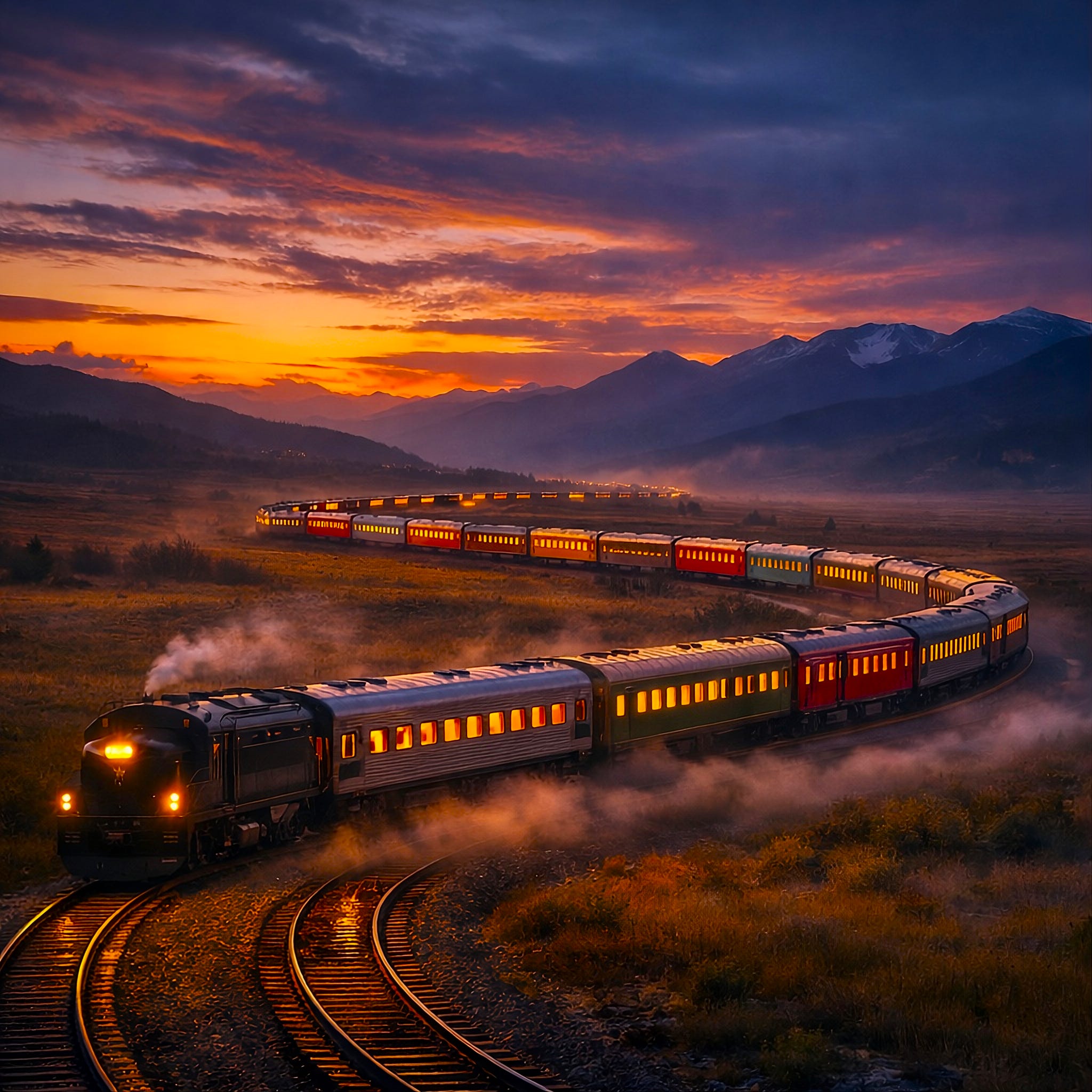
Long Train Home - Full Procession (1:12:57)
Stream/Download Free MP3:
Some songs are houses. Some are mirrors. And some are trains.
When Pat Metheny released Last Train Home in 1987, he built not merely a composition, but a departure platform. The soft percussion ticking like steel kissing steel, the suspended ache of melody drifting across dusk-lit tracks, the sense that something is leaving and arriving at once. That opening rhythm always felt unfinished in the most beautiful way, like boxcars waiting to be coupled.
I heard the space between the wheels. So I didn’t remix. I extended the railway.
Long Train Home begins where the engine exhales. The first carriage carries reverence. The second experiments with reflection. By the fifth, the countryside changes. By the ninth, the terrain is unfamiliar. By the fifteenth, the original silhouette is barely visible against a widening horizon. And yet the rhythm of the rails remains, steady as breath.
Twenty-one adaptations. Twenty-one cars. Each one increasingly differentiated, like identities evolving as they move further from origin.
My process mirrors the metaphor. Human intuition laid the track. ChatGPT and Producer.ai helped survey new landscapes. In Audacity 3.7.7, running on Linux Ubuntu 25.10, I became both engineer and conductor. Edits were seamless and variously synced couplings. Fades were junctions. EQ curves bent like rail lines. The train percussion motif became the recurring axle, the rotational truth beneath stylistic travel across a vast landscape.
This was not automation. It was orchestration, arrangement of sonic cars. The AI did not replace the hand. It extended it. The way a locomotive extends the will of a traveler. The way rails extend intention across distance.
By the final two adaptations, something remarkable happens. The caboose remembers the engine. Familiar harmonics return, but altered. Weathered. Seasoned by distance. It is not nostalgia. It is integration. The home returned to after a long journey is never identical to the one first left. Nor are you, ideally.
The train that began as “Last” becomes “Long.” Not an ending, but a continuum. Not a farewell, but an unfolding.
In an era obsessed with instant arrival, this work insists on passage. On progression. On continuity. It asks what happens when we refuse to disembark at the first station and instead let the idea travel its full length.
Steel on steel. Memory on memory. Car after car after car. Until home is no longer a place, but a stream of universal being that connects everything.