
Outside Outside (2095)
A Future Autopsy of Bowie’s Unfinished Experiment

AI Gen Process/Software: Human, ChatGPT, Perchance.org, Producer.ai – DAW: Audacity 3.7.7, OS: Linux (Ubuntu 25.10)
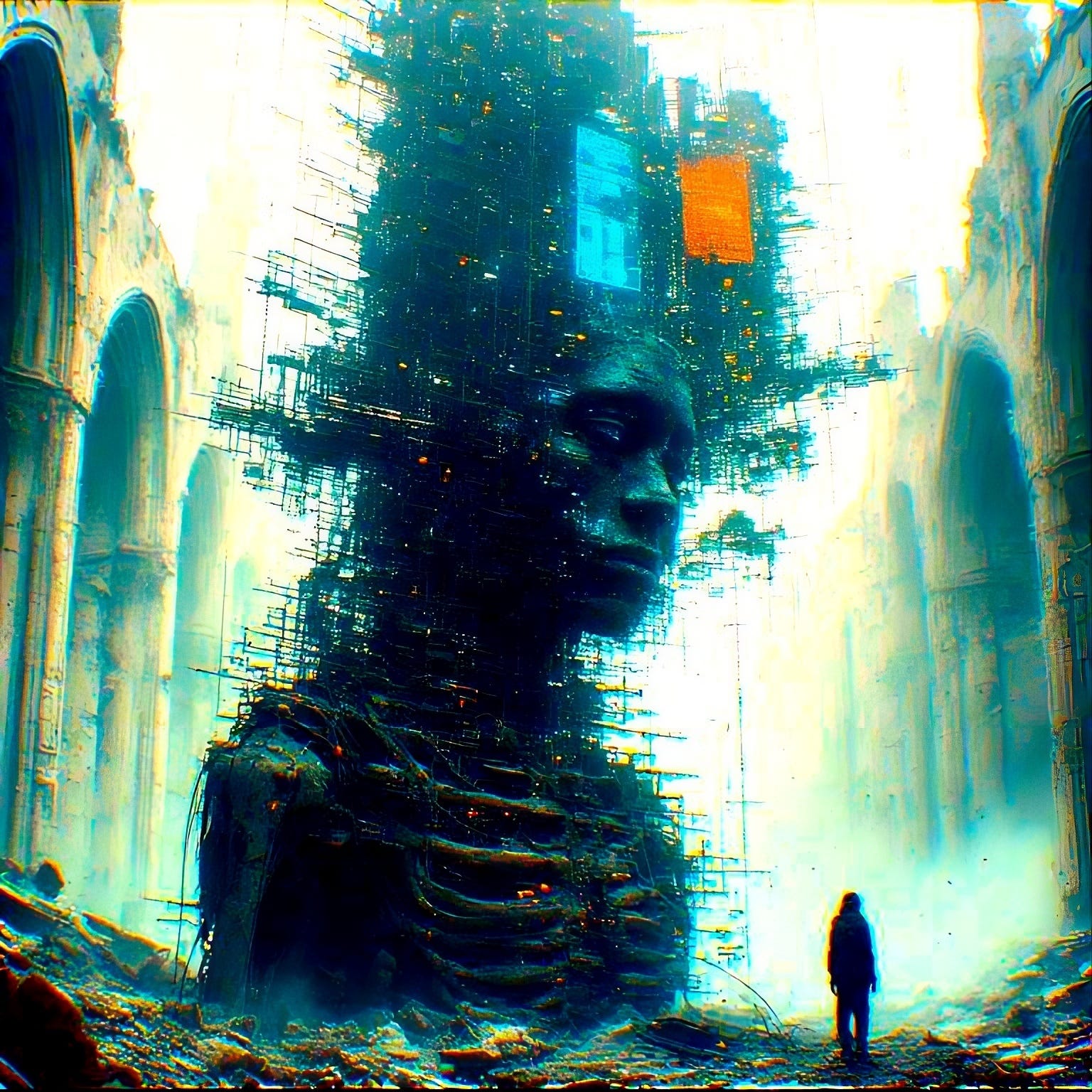
Part Seven of the Bowie Series
Outside Outside (2095) – Full Album (1:14:37)
Stream/Download Free MP3
David Bowie’s Outside album (1995) was another major artistic transformation for him. It was a total deconstruction and reconstruction of self, a reinvention, a rebirth. Outside was Bowie detonating his own comfort. A fragmented cyberpunk narrative, industrial textures, moral ambiguity, and deliberate incompleteness.
Bowie was no longer chasing relevance. He was testing the future. This album repositioned Bowie as an avant-garde artist again, but this time aligned with contemporary experimental culture rather than classic rock heritage. I wanted to adapt the album so it continued its alignment to contemporary experimental culture, but I not limited to 2026. I set it in the distant future. Do you think that you could imagine how “Outside” might have sounded if created 100 years from now? And how would you describe that sound, as an album level text to music prompt? I did.
It’s a deliciously dangerous idea, because Outside already behaves like an artifact smuggled backward through time. To imagine it 100 years forward is not futurism. It’s archaeology of the unborn.
If Bowie detonated his comfort in 1995, Outside Outside (2095) would be the sound of a consciousness that no longer believes in the stability of bodies, authorship, or linear memory.
This is how it might feel before how it would sound:
In this future, art is no longer released. It leaks. Identity is modular. Crime is ontological. Music exists as a residue of data trauma, half-heard, half-remembered, constantly mutating depending on the listener’s neural state. There is no nostalgia, only corrupted recall.
Bowie wouldn’t be narrating a cyberpunk murder. He’d be documenting the failure of meaning itself after centuries of aesthetic saturation.
What changes from 1995 to 2095
Industrial becomes post-industrial silence
Not machines clanging, but the afterimage of machines. Negative space where factories once screamed.Cyberpunk becomes post-human ritual
No chrome, no neon. Instead: memory vaults, ghost protocols, AI liturgies.Narrative collapses further
No characters you can name. Only perspectives. Files. Witness fragments. Testimony that contradicts itself mid-sentence.Vocals are no longer “performed”
They emerge, degrade, fork, and reassemble as multiple degrees of the gender spectrum. Sometimes they sound like Bowie, the man. Sometimes like his feminine range. Sometimes like a deeper masculinity. Sometimes like an androgynous human, or machine. Sometimes like a corrupted descendant or ascendant of all. Sometimes like you.
How Outside would sound 100 years from then
Tempo: Elastic, non-linear. Beats appear, dissolve, return altered. Time feels edited rather than counted.
Harmony: Microtonal, unstable, emotionally ambiguous. Beauty that never resolves.
Rhythm: Asymmetrical pulses derived from biometric data, neural drift, decaying clock systems.
Texture: Airless and vast at the same time. The sensation of standing inside a server cathedral buried beneath ruins.
Emotion: Not anger or fear, but forensic curiosity. The feeling of examining your own erased past.
Initial Album-Level Text-to-Music Prompt
Create a fractured, post-human experimental track. Sonically blend post-industrial ambient, neural glitch, bio-digital ritual music, and forensic sound design. Replace traditional drums with irregular biometric pulses, degraded signal rhythms, and algorithmic decay patterns. Use silence as a structural element.
Vocals should be female or male or outside of that binary construct, and feel semi-conscious: whispered, fragmented, time-stretched, pitch-warped, occasionally synthetic, occasionally intimate. Voices may split into multiple perspectives, change degrees of gender, and back, overlap, or abruptly terminate, as if corrupted mid-transmission.
Harmonic language should be dissonant yet emotionally precise, using unresolved chords, and unstable drones. Melodies should feel like memories attempting to reassemble themselves, but incorrectly.
Atmosphere should evoke abandoned data centers, memory archives, post-urban ruins, and ritual spaces where humans and AI attempt to reconstruct meaning from cultural wreckage.
The overall tone is cold, intimate, analytical, and at times unsettling, yet deeply human beneath the digital corrosion. This is not music for entertainment. It is a future autopsy of identity, culture, and desire.
If 1995’s Outside was Bowie standing at the edge of the 21st century asking “what comes next?”, this version is what answers back at the edge of the 22nd century.
We survived. But we don’t remember how we used to be.
When David Bowie released Outside in 1995, he didn’t pivot. He ruptured.
This was not a stylistic refresh or a bid for relevance. It was an intentional dismantling of authorship, identity, and narrative itself. Bowie abandoned the comforts of song form, stable characters, and moral clarity, replacing them with fragments, dossiers, voices that contradicted themselves, and a world that refused to explain its crimes. Melody became unstable. Structure became suspect. Completion became optional.
Outside marked Bowie’s return to the avant-garde, but not by revisiting past experiments. Instead, he embedded himself in the cultural nervous system of the mid-90s: industrial textures, cyberpunk anxiety, ambient unease, and the dawning realization that technology would not simply extend humanity, but interrogate it. Art was no longer decorative or declarative. It was forensic.
Most radically, Bowie relinquished control. He positioned himself less as narrator and more as witness, curator, and unreliable transmitter. The album behaved like a corrupted archive rather than a finished statement. Meaning leaked instead of landing. This was Bowie detonating his own mastery, choosing uncertainty over legacy.
And crucially, Outside was unfinished by design. Bowie left doors open, threads hanging, futures implied but never resolved. The album wasn’t meant to be concluded. It was meant to evolve.
That is where this adaptation begins.
Rather than recontextualizing Outside through the familiar lens of 2025, I chose to follow its trajectory forward, not sideways. To ask not how Outside would sound today, but how it might manifest after a century of cultural acceleration, identity fragmentation, and aesthetic saturation. I didn’t modernize it. I time-traveled it.
Why 2095? Because Outside was never about the present moment. It was about pressure. About stress-testing identity against systems that outgrow their creators. A hundred years felt like the minimum distance required for the album’s questions to fully mutate. In that future, industrial becomes post-industrial absence. Cyberpunk sheds its chrome and becomes ritual. Narrative collapses into evidence. Voice becomes unstable. Authorship dissolves.
This is not speculation for novelty’s sake. It is fidelity to Bowie’s method. He never lingered where he was understood. He moved to where language hadn’t stabilized yet. If Bowie were continuing Outside, he wouldn’t be polishing it for contemporary tastes. He would be placing it where meaning itself is unreliable, where art functions less as expression and more as artifact.
This adaptation imagines Outside as a future autopsy of culture: music as residue, memory as glitch, emotion as data scar. Not entertainment. Not commentary. Evidence.
Bowie once said:
“Tomorrow belongs to those who can hear it coming.”
Outside heard it first. Outside Outside lets it arrive.
Reading this made me think about Johann Sebastian Bach, and how some music stays alive long after its time because it’s built on listening and structure rather than style. Placing Outside in 2095 feels like a similar question about what actually endures when context shifts. Really interesting approach.