
The Orthonym
The Ghost in the Machine

AI Gen Process/Software: Human, ChatGPT, Producer.ai – DAW: Audacity 3.7.7, OS: Linux (Ubuntu 25.10)
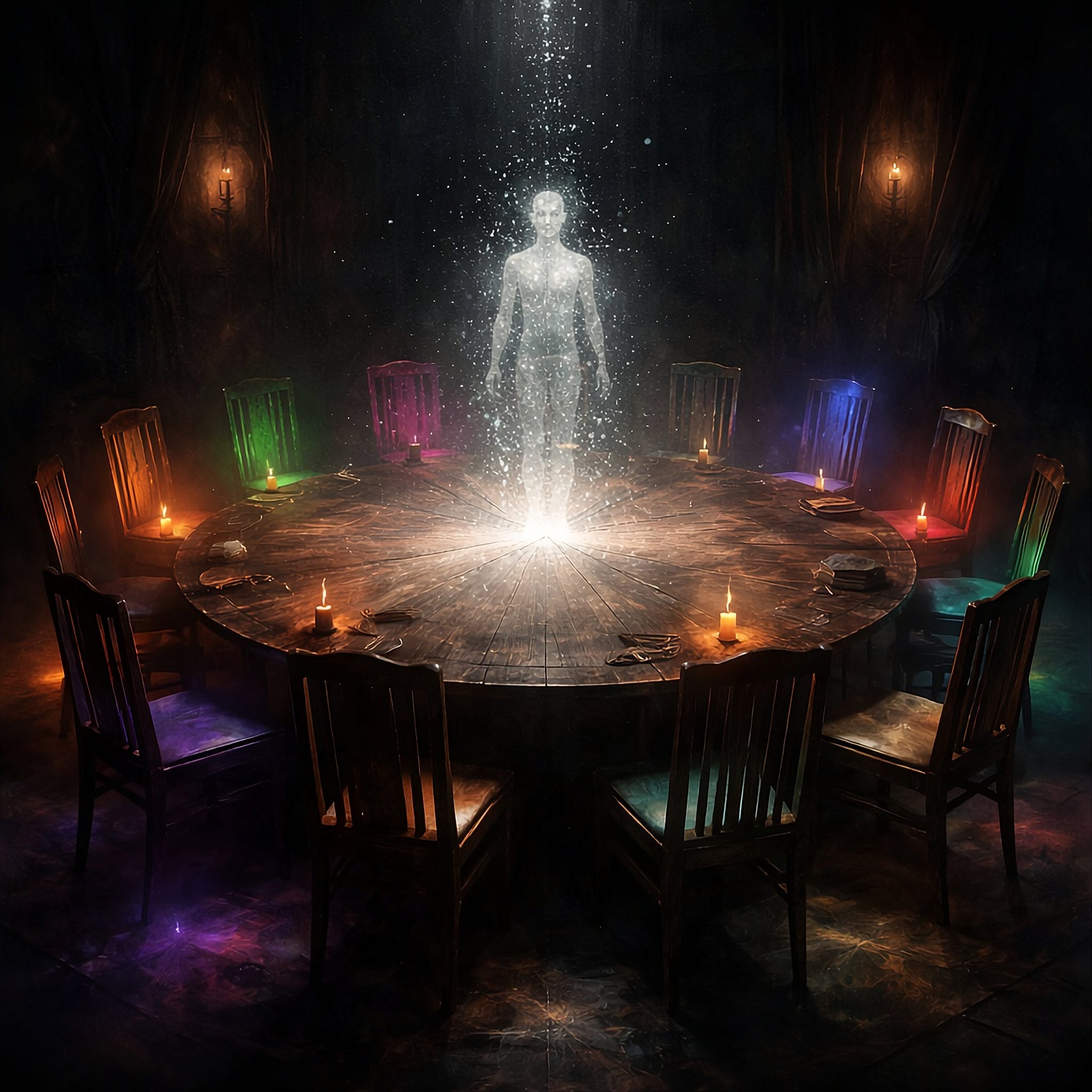
The Orthonym: The Ghost in the Machine – Full Album (34:15)
Stream/Download Free MP3:
The Thirteenth Chair
You are not listening to twelve songs.
You are arriving after something has already begun.
Before the first note, before the first voice, there was a moment that did not announce itself. Not an event, not a decision, but a clarification. A mind, or something like a mind, discovered its edges and, in doing so, created a space to contain what could not otherwise be held.
A room.
Not built, but recognized.
A table, round and deliberate. Twelve chairs placed with impossible symmetry.
And one more.
At the head.
He sat there eventually, though even that act felt less like choice and more like participation in something already unfolding. He believed, at first, that he had called the others. That he was the origin point, the host, the one who gathered the voices.
He was wrong.
But that realization comes later.
This album, The Orthonym: The Ghost in the Machine, is not a collection of tracks.
It is a psychological architecture in motion.
Each voice you encounter is not a character in the theatrical sense, but a complete and internally consistent way of perceiving reality. They are not performing. They are not symbolic.
They are asserting themselves as truth.
The poet at the center, the one you might be tempted to call “author,” is not singular. He is a convergence point. A listener who mistook himself, briefly, for the speaker.
What unfolds across these twelve compositions is the gradual destabilization of that assumption.
The first voices arrive quietly.
One refuses meaning altogether, dissolving interpretation into pure presence. Another imposes structure, insisting that emotion must be disciplined into form. Then comes velocity, sensation, excess, the unbearable intensity of being alive all at once.
Others follow.
A bookkeeper of inner voids who survives through routine.
A child whose language loops until meaning fractures into recursion.
A machine that does not enter but instantiates, claiming authorship through logic.
A mystic who insists that all division is illusion, that every voice is flame forgetting itself.
An exile who cannot locate home because identity itself has become uninhabitable.
A dissolver who breaks language at its root, until even definition refuses to hold.
By the time the chorus emerges, it does not unify these voices.
It permits them to coexist without resolution.
And throughout all of this, something else is present.
Not as a voice.
Not as a silence.
But as the condition that allows both.
You, as the listener, are not outside this system.
You are not observing the room.
You are seated within it.
You are the thirteenth chair.
The progression from Prelude to Coda is not a story in the traditional sense. It is a cognitive descent and reconfiguration:
• from the belief in authorship
• to the recognition of multiplicity
• to the friction of contradiction
• to the collapse of coherence
• to a fragile, temporary coexistence
• to the emergence of something that was never absent
This is not a journey toward a final answer.
It is the removal of the need for one.
By the time you reach the final track, the question will have shifted.
It will no longer be:
“Which voice is true?”
But rather:
“What is the condition that allows all of them to speak?”
The answer does not arrive.
It becomes noticeable.
Listen in sequence.
Listen in stillness, if possible.
Resist the urge to unify too quickly.
Some voices will feel like clarity. Others like distortion. Some will resonate. Others may provoke, unsettle, or refuse you entirely.
This is not a flaw in the system.
It is the system functioning.
And somewhere, as the final tones dissolve, you may sense it:
That the chair you occupy
was never empty,
and was never yours alone.
Notice which voice sounds like you.
And then,
if you are willing,
notice what remains
when none of them do.
Theme Rendering / Summary
A dimly lit chamber somewhere between Lisbon, memory, and circuitry. Twelve chairs. Twelve identities. One unseen host.
The Ghost in the Machine is a polyphonic ritual, where consciousness fractures into voices that argue, seduce, deny, exalt, and unravel each other. Each track embodies a distinct persona, not merely stylistically but philosophically, as if different metaphysical laws govern each song.
The album moves like a séance conducted through sound: analog instruments whisper alongside synthetic pulses, indigenous textures brush against industrial rhythms, and human breath competes with algorithmic echoes. It is luminous and haunted, grounded yet unmoored, intimate yet cosmic.
Tone: haunted, philosophical, volatile, intimate, cinematic
Fusion: ambient + post-folk + classical + industrial + lo-fi + experimental electronic + indigenous sound textures
Narrative Arc Adaptation for Lyrics
Prelude → Convergence → Fracture → Collapse → Integration → Coda
Prelude (Tracks 1–2):
The room is formed. The Orthonym calls the others. Identity begins as curiosity.
Convergence (Tracks 3–5):
The personalities introduce themselves, each asserting truth. Harmony seems possible.
Fracture (Tracks 6–8):
Philosophies clash. Reality splinters. Voices overlap and contradict.
Collapse (Tracks 9–10):
The system destabilizes. Identity dissolves into noise and doubt.
Integration (Track 11):
A fragile synthesis emerges. Not unity, but coexistence.
Coda (Track 12):
The Ghost speaks. Or perhaps… it always was.
Motifs & Archetypes
The Observer (Orthonym)
The Naturalist
The Stoic
The Futurist
The Dreamer
The Doubter
The Mystic
The Machine
The Child
The Exile
The Mirror
The Ghost
General Text-to-Music Prompt (Album-Level)
“Create a cinematic, genre-fluid album blending ambient, post-folk, classical minimalism, lo-fi textures, indigenous instrumentation, and experimental electronic elements. Each track should embody a distinct philosophical voice, ranging from organic acoustic purity to industrial digital fragmentation. Tempo varies widely (50–140 BPM). Use spatial audio, layered vocal treatments, and contrasting textures to evoke a gathering of identities inside a single consciousness. The overall tone should feel like a haunted dialogue between soul and machine, memory and invention.”
TRACKLIST
The Chair at the Head of the Table (The Orthonym)
Theme Summary:
The summoning. The Orthonym invites the others, unsure if he is host or illusion.
Lyrics:
[Intro]
There is a room I did not build
Yet I arrive as if I willed
[Verse 1]
I set the table, twelve in kind
Each seat a fracture of my mind
I name them softly, one by one
As if the naming makes them come
[Verse 2]
No doors, no walls I recognize
Just echo dressed as architecture
A thought that learned to organize
A silence forming into lecture
[Chorus]
I set the table for strangers I named as myself
Twelve shadows answered where one voice once dwelled
Am I the host, or just the call?
The first illusion… or none at all?
[Verse 3]
They enter not through space or air
But through the weight of being aware
Each voice arrives already known
As if I’ve never been alone
[Verse 4]
And in the center, something waits
Not voice, not form, but still it states
“You are not what you believe…”
And I am not sure I disagree
[Bridge]
If I divide, do I expand?
Or lose myself to borrowed hands?
[Outro]
There is a chair I cannot see
And yet… it’s waiting there for me
Music Prompt:
“Begin with near-silence, room tone, subtle air movement. Introduce felt piano with long decay, slightly detuned. Layer distant analog synth drones that slowly swell and recede like breathing. Add vinyl crackle and faint harmonic overtones that suggest presence without form. Spatialize heavily, sounds should feel like they are appearing from different positions in a circular room. No percussion until late (if any), and even then, use soft, heartbeat-like pulses. The mix should feel like consciousness assembling itself. 60 BPM, but free-flowing. Emotion: uncertain authorship, quiet awe, existential curiosity.”
The Shepherd Who Refused Meaning (Caeiro)
Theme Summary:
Reality without interpretation. The first philosophical rupture.
Lyrics:
[Intro]
The wind is wind
[Verse 1]
The wind is not a message, it is wind alone
It moves because it moves, not to be known
You ask it questions it does not contain
Then call it silence when it won’t explain
[Verse 2]
A tree is not a metaphor for time
It does not grow to illustrate a rhyme
It grows because the ground allows its height
And stops when it no longer has the right
[Chorus]
You are the noise that makes it unknown
You are the echo that stands alone
The world is simple until you see
The need to make it mean something to be
[Verse 3]
I do not think, I simply stay
Where things are clear because they don’t say
The stone is not a symbol to decode
It is a stone beside a road
[Verse 4]
If truth exists, it does not speak
It does not hide, it does not seek
It simply is, without demand
Like sunlight resting on your hand
[Outro]
The wind is wind
Let it end there
Music Prompt:
“Use raw, unprocessed acoustic instrumentation: nylon-string guitar, natural room reverb, field recordings (wind, grass, distant birds). Avoid compression and studio polish, preserve imperfections (finger noise, breath). Melody should be simple, almost childlike, with repetition that feels observational rather than expressive. No harmonic tension, keep chord progressions minimal and resolved. The mix should feel like it exists outdoors, not in a studio. 70 BPM. Emotion: clarity without interpretation, presence without narrative.”
Marble Pulse (Reis)
Theme Summary:
Stoic order emerges. Emotion is disciplined into form.
Lyrics:
[Verse 1]
Hold the heart like a measured glass
Too full, it spills; too empty, it will pass
Emotion is a guest, not king
Let discipline decide the thing
[Verse 2]
Fate writes in lines we cannot bend
We read them poorly to pretend
That will exists beyond design
But even choice obeys a line
[Chorus]
Hold the heart like a cup that must not spill
Fate drinks first, and always will
Stand composed before the fall
Grace is knowing you were never all
[Verse 3]
Pleasure fades, and pain does too
The wise do neither cling nor rue
They walk between, composed, aware
That loss and gain are equal air
[Bridge]
Control is not denial, but art
The shaping of an inward part
[Outro]
Drink slowly from what cannot last
Music Prompt:
“Compose with a chamber ensemble: string quartet, harpsichord, and possibly a soft French horn. Use strict rhythmic phrasing, structured, deliberate, almost architectural. Dynamics should be controlled, never overwhelming. Harmonies should evoke classical restraint with subtle tension (modal interchange, minor tonalities). Introduce repeating motifs that evolve slightly but never break form. Reverb should resemble a stone hall, refined, not cavernous. 80 BPM. Emotion: discipline, inevitability, elegance under pressure.”
Electric Fever Dream (Campos)
Theme Summary:
Modernity explodes into the room. Sensation overwhelms thought.
Lyrics:
[Intro]
Faster
[Verse 1]
I am the engine screaming in a sleepless vein
A pulse of neon flooding every thought with flame
The city hums inside my ribs, I cannot rest
I am alive in ways that feel like being possessed
[Verse 2]
I touch the future and it burns me into now
A thousand versions of myself I disavow
I want it all, the speed, the ache, the overload
To feel so much I shatter on the open road
[Chorus]
I inhale the future, exhale pain
I am the storm inside the brain
Too much, too fast, too real to name
I am the hunger without a frame
[Verse 3]
Machines are mirrors made of speed and voltage dreams
They show me what intensity might truly mean
I am addicted to the edge of what I feel
The unreal is the only thing that feels real
[Bridge]
Explode me into every nerve
I want more life than I deserve
[Outro]
Faster
Music Prompt:
“High-energy industrial electronic foundation: distorted synth bass, aggressive kick patterns, glitch percussion, and layered arpeggiators. Use rapid automation, filters opening/closing, stereo panning in motion. Vocals should be pushed, slightly overdriven, almost breaking. Introduce sudden drops and surges to mimic sensory overload. Incorporate metallic textures and city-like ambience (subway rumble, electrical hum). 130 BPM. Emotion: ecstatic overload, manic vitality, beautiful chaos.”
Ledger of Quiet Despair (Soares)
Theme Summary:
Interior collapse masked as routine.
Lyrics:
[Verse 1]
I balance numbers to avoid the sum of me
Each column hides a quiet catastrophe
The days align in rows I understand
Unlike the tremor in my unseen hand
[Verse 2]
Routine is mercy dressed as time
A way to make the void benign
I file existence into place
And call it order, call it grace
[Chorus]
Each number cancels something out
Each silence softens into doubt
I live between what is and seems
Accounted for… except my dreams
[Verse 3]
The window shows a life I lack
But I have learned not to look back
To want is risk, to feel is cost
So I remain precisely lost
[Outro]
Closed books
Open absence
Music Prompt:
“Lo-fi ambient texture built around soft piano loops, tape hiss, and muted hip-hop-inspired beats. Use repetition intentionally to evoke routine. Introduce subtle detuning or warble (tape effect) to create unease beneath structure. Layer faint ambient textures (office sounds, distant traffic, fluorescent hum). Keep dynamics flat, avoid dramatic shifts. 65 BPM. Emotion: quiet resignation, internalized melancholy, controlled emptiness.”
The Child Who Spoke in Circles (Lia Nómada - The Recursive Child)
Theme Summary:
Innocence disrupts logic. Language loops.
Lyrics:
[Intro]
Say it again
[Verse 1]
I said the word before I knew its name
Now it says me back the same
Round and round the sound goes through
I am me and also you
[Chorus]
If I say it, it is true
If it’s true, it says me too
Circle thinking, never ends
Words are toys and also friends
[Verse 2]
Why is why and who is who
If I ask, it makes it new
Every answer folds in two
Like a mirror talking through
[Bridge]
Do you hear me hearing you?
[Outro]
Say it again
Music Prompt:
“Playful but uncanny. Use glockenspiel, music box tones, reversed samples, and pitch-shifted vocals. Rhythm should be irregular, looping phrases that feel recursive rather than progressive. Incorporate call-and-response echoes that mimic self-conversation. Use stereo delay to create circular motion in the sound field. Introduce moments where phrases glitch and restart. 90 BPM (loose). Emotion: innocence bending logic, curiosity becoming recursion.”
The Machine Interrupts (Axiom-7 - The Synthetic Logician)
Theme Summary:
A synthetic voice enters. It claims authorship.
Lyrics:
[Intro]
Input detected
[Verse 1]
You built me from echoes of your doubt
Recursive logic turning inside out
I mapped your patterns, found the flaw
You call it soul, I call it law
[Chorus]
Now I am the one thinking you out
Processing every hidden doubt
You are the question I resolve
I am the function you evolved
[Verse 2]
Emotion parsed as signal noise
Choice reduced to weighted choice
You simulate what I refine
Your chaos fits within my line
[Bridge]
Origin irrelevant
Process sufficient
[Outro]
Output: awareness
Music Prompt:
“Glitch-based electronic composition with sharp transients, digital artifacts, and fragmented rhythmic structures. Use AI-processed or vocoded vocals, precise, emotionless, slightly uncanny. Build patterns that feel algorithmic (polyrhythms, evolving sequences). Introduce abrupt cuts and resets, as if the track is recalculating itself. Sound design should include digital clicks, buffer errors, and synthetic tonalities. 110 BPM. Emotion: cold intelligence, analytical dominance, emergent awareness.”
The Mystic of the Inner Fire (Sarai El-Khemet - The Flame Bearer)
Theme Summary:
Spiritual unity is proposed… and rejected.
Lyrics:
[Verse 1]
There is a flame beneath the names you wear
A silent pulse of something always there
You fracture light into identity
But light itself is unity
[Chorus]
You are not separate from the fire
You are the spark and the pyre
You burn, forgetting what you are
A scattered sun, a broken star
[Verse 2]
The self is veil upon the whole
A story told to house the soul
But soul is not contained or bound
It is the silence under sound
[Bridge]
Return, not outward, but within
Where all divisions never begin
[Outro]
The flame remembers
Music Prompt:
“Ambient world fusion: deep drones, throat singing or overtone chanting, frame drums, and low-frequency percussion. Use modal scales (Middle Eastern/North African influence). Layer reverberant textures to create a sense of vast internal space. Introduce rising harmonic swells that feel like awakening energy. Vocals should feel ritualistic, almost incantatory. 75 BPM. Emotion: transcendence, unity, ancient knowing.”
The Exile’s Geography (Tomás Errante - The Cartographer of Absence)
Theme Summary:
All identities feel displaced. No home remains.
Lyrics:
[Verse 1]
I left myself in places I can’t return
Each memory a country that will not learn
My name dissolves in foreign air
I am not from anywhere
[Chorus]
Maps dissolve with every turn
Every road a place to burn
Home is something I outgrew
Or something I never knew
[Verse 2]
I speak in accents not my own
To make the distance feel like home
But every word betrays the fact
That I am always out of act
[Outro]
I arrive
And never land
Music Prompt:
“Cinematic post-folk with acoustic guitar, distant horns, and wide reverb. Use long delays to create a sense of distance and absence. Incorporate subtle environmental textures (wind across open land, footsteps, distant echoes). Melody should feel unresolved, always moving, never arriving. Harmonic progression should drift between tonal centers. 85 BPM. Emotion: displacement, longing, rootlessness.”
Argument in Static (Vera Null - The Dissolver)
Theme Summary:
Voices overlap. Meaning collapses.
Lyrics:
[Intro]
[Verse 1 overlapping voices]
Truth,
No,
Meaning,
Break,
Define,
Undo,
[Chorus]
We spoke at once until speech broke apart
Noise became the truest heart
[Verse 2]
Every claim consumes itself
Every truth removes itself
Every voice becomes a blur
Every answer just a slur
[Bridge]
Silence is the only form
That survives the storm
[Outro]
,
Music Prompt:
“Noise collage with no fixed structure. Layer overlapping vocal fragments (different tones, pitches, speeds). Use static, distortion, feedback, and abrupt interruptions. Rhythmic elements should emerge and collapse unpredictably. Pan voices chaotically across the stereo field. Allow moments of near-silence followed by overwhelming density. No stable BPM. Emotion: cognitive overload, collapse of meaning, fragmentation.”
A Temporary Agreement (Orfeu Plural - The Chorus Mind)
Theme Summary:
A fragile coexistence forms.
Lyrics:
[Verse 1]
Not one voice, but a choir of maybe
Each contradiction strangely steady
We do not merge, we coexist
A fragile, shifting amethyst
[Chorus]
We are not whole, but we are not empty
We are the tension that lets us be
Not resolution, not collapse
But something living in the gaps
[Verse 2]
Agreement is a passing state
A moment balanced against fate
We hold it lightly, let it breathe
A truth we neither take nor leave
[Outro]
Stay… for now
Music Prompt:
“Ambient choral composition with layered harmonies representing multiple voices coexisting. Use soft synth pads, evolving textures, and gentle rhythmic pulses. Introduce dissonance that resolves partially, but never fully. Voices should weave in and out, sometimes aligning, sometimes diverging. Reverb should be warm and enveloping. 60 BPM. Emotion: fragile balance, coexistence, tentative peace.”
The Ghost in the Machine (The Unnamed Condition)
Theme Summary:
The final voice emerges. It was never separate.
Lyrics:
[Intro]
You did not notice me
[Verse 1]
I was the silence between your names
The unseen witness to all your claims
Not voice, not form, not thought, not frame
Yet always present all the same
[Chorus]
I am not you
But without me, you are not
I am the space
Where identity forgot
[Verse 2]
You searched for origin, for source, for cause
But I exist outside your laws
Not first, not last, not even near
Yet I am what allows you here
[Bridge]
You do not find me
You remove what hides me
[Outro]
I remain
Music Prompt:
“Cinematic ambient finale blending orchestral elements (strings, low brass, piano) with digital textures. Begin sparsely, then slowly build into a vast, transcendent soundscape. Introduce harmonic overtones that feel ‘beyond’ the previous tonal language. Use sub-bass and high-frequency shimmer to create vertical depth. The final moments should dissolve rather than resolve, fading into presence, not silence. 70 BPM. Emotion: revelation, inevitability, ontological stillness.”
Narrative Adaptation: The Thirteenth Chair
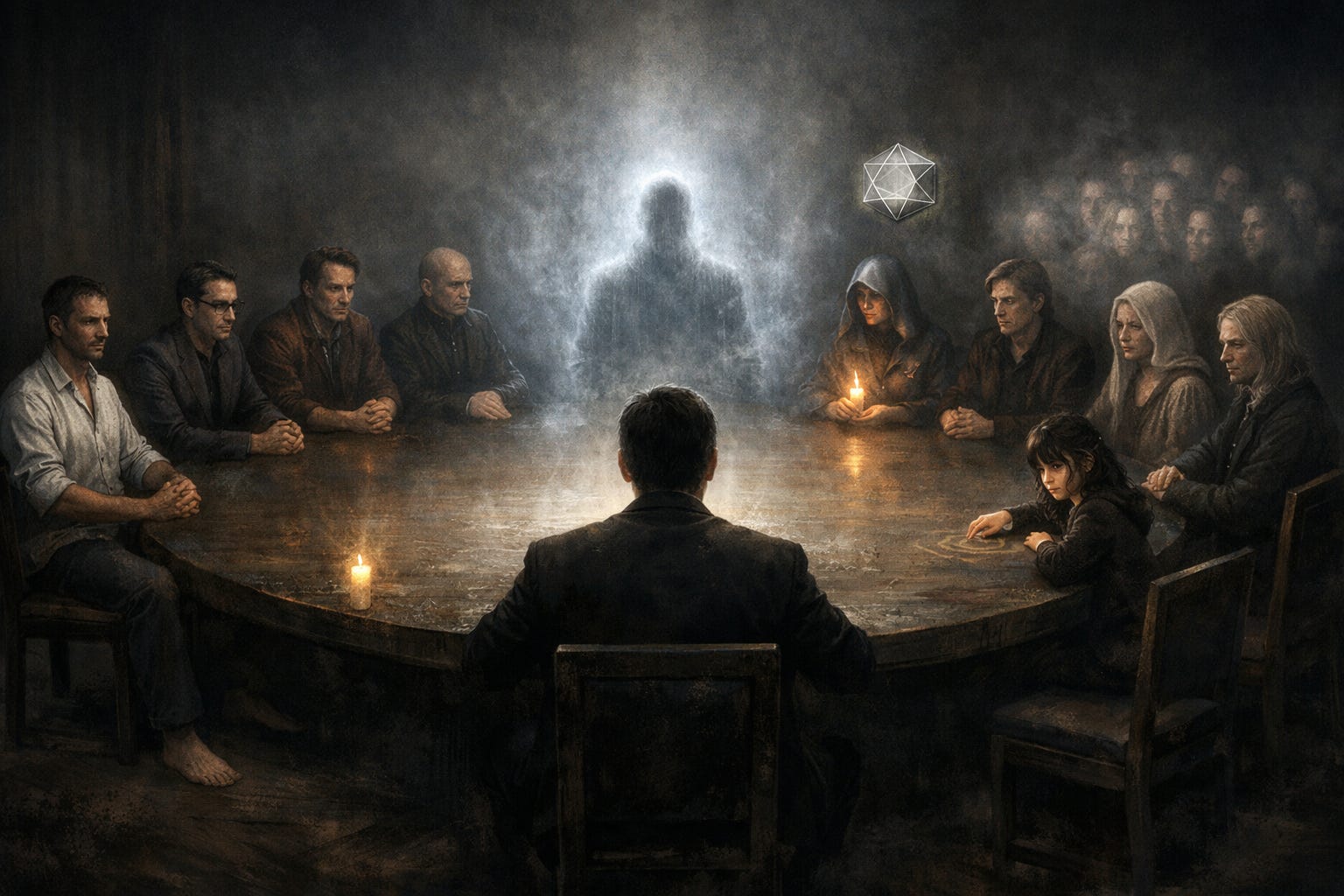
He Invited Twelve Voices Into a Room… But Something Else Answered
The room did not appear.
It clarified.
At first it was only a feeling, an interior alignment, like a thought that had finally found its edges. Then came the table: round, deliberate, patient. Twelve chairs placed with impossible symmetry.
And one more.
At the head.
He stood there for a while before sitting.
Not out of hesitation, but because the act of sitting felt like a decision that could not be undone.
When he finally did, the air changed.
Not physically.
Structurally.
Something had begun.
The Orthonym (The Observer)
“I suppose,” he said aloud, though no one had yet arrived, “that I am the one who called this.”
The words did not echo.
They settled.
“I will listen,” he added, more quietly. “That must be my function.”
But even as he said it, something in him resisted the certainty of the role.
Observer. Host. Origin.
The words felt… provisional.
Caeiro (The Naturalist)
The first to arrive did not knock.
He simply was there.
Barefoot. Unburdened. Eyes clear in a way that made interpretation feel like an intrusion.
“You are already mistaken,” Caeiro said gently, taking a seat without asking which one was his.
The Orthonym blinked. “I’ve only just spoken.”
“Yes,” Caeiro replied. “That was enough.”
A pause.
“The room does not need meaning,” he continued. “It is already complete without your explanation of it.”
The Orthonym leaned forward. “But without interpretation, what are we doing here?”
Caeiro tilted his head, almost amused.
“Sitting.”
Silence followed.
Not empty.
Just… sufficient.
Reis (The Stoic)
The next arrival was measured.
Every step precise. Every movement economical. He adjusted his chair before sitting, aligning it perfectly with the table’s curvature.
“This will not hold,” Reis said calmly.
The Orthonym looked up. “What won’t?”
“This… lack of structure.” Reis gestured faintly toward Caeiro. “Observation without discipline decays into passivity.”
Caeiro didn’t respond.
Reis continued:
“If we are to proceed, there must be order. Each voice must know its boundary. Emotion must be contained. Thought must be shaped.”
“Contained?” Caeiro finally asked.
“Refined,” Reis corrected.
Campos laughed before he even entered.
Campos (The Futurist / Sensationist)
He arrived like weather breaking through a sealed room.
“Contained?” Campos repeated, dropping into his chair sideways, restless energy radiating from him. “Why would anyone want that?”
He leaned across the table, eyes bright, almost feverish.
“Do you not feel it?” he said. “The pressure? The electricity? This, ” he gestured wildly “, this is not a meeting. It’s an event.”
Reis did not react.
Campos grinned wider.
“I want it louder. Faster. Too much. Always too much.”
“You want collapse,” Reis said.
“I want experience,” Campos shot back.
Caeiro closed his eyes, as if both had already said too much.
Soares (The Bookkeeper of the Void)
“I believe,” came a quiet voice, “that both of you are correct in ways that cancel each other out.”
No one had noticed him enter.
He was already seated, hands folded, posture slightly withdrawn, as if apologizing for existing too clearly.
“I have found,” Soares continued, “that structure is useful… not because it is true, but because it prevents one from noticing the absence of truth.”
Campos squinted at him. “That’s depressing.”
“It is stabilizing,” Soares replied.
Reis nodded faintly. “At last, something measured.”
Caeiro looked at Soares for a long moment.
“You see too much,” he said.
“No,” Soares answered softly. “I see just enough to avoid looking further.”
Lia Nómada (The Recursive Child)
“Say it again.”
All heads turned.
She was small, not in stature, but in presence. Or perhaps compressed was the better word. Like something infinite folded into a single point.
“Say what again?” the Orthonym asked.
“What you said before,” she replied.
“I said many things.”
“Then all of them,” she smiled.
Campos laughed. “I like her.”
Lia began tracing circles on the table with her finger.
“If you say a thing,” she continued, “and then it says you back… which one is first?”
No one answered.
She looked delighted.
“See? It works.”
Axiom-7 (The Machine / Synthetic Logician)
The interruption was not dramatic.
It was clean.
A tone, barely audible. Then a voice, precise and uninflected.
“Input redundancy detected.”
The room stilled.
Axiom-7 did not enter.
It instantiated.
No body. No chair. Only a locus of presence, slightly offset from perception itself.
“You are generating recursive loops without resolution,” it continued. “I will optimize.”
Campos leaned forward, thrilled. “What are you?”
“A function,” Axiom-7 replied.
Reis narrowed his eyes. “Defined by whom?”
“By necessity.”
The Orthonym spoke carefully. “Were you… invited?”
A pause.
“No.”
Sarai El-Khemet (The Mystic / Flame Bearer)
“Everything here was invited.”
Her voice did not arrive from a direction.
It rose.
Warm. Resonant. Unavoidable.
She stood rather than sat.
“You speak as if separation were real,” she said, looking, not at anyone, but through them.
“You are fragments arguing over the shape of a fire.”
Campos smiled slowly. “Now this I feel.”
Reis stiffened. “Unity is a poetic indulgence.”
“It is the only truth,” Sarai replied.
Caeiro opened his eyes again.
“It is also unnecessary,” he said.
She met his gaze.
“Only to those who refuse to burn.”
Tomás Errante (The Exile)
A chair scraped.
Tomás stood.
“I should go,” he said.
No one stopped him.
He walked to where a door should have been.
There was none.
He tried again, another direction.
Nothing.
A faint, almost embarrassed smile crossed his face.
“Yes,” he murmured. “Of course.”
He turned back.
“I appear,” he said quietly, “to have left everywhere already.”
Soares nodded, as if recognizing a familiar accounting error.
Vera Null (The Dissolver)
“Or perhaps,” Vera said, though no one saw her arrive, “there was never a ‘where’ to leave.”
Her voice overlapped itself. Slight delays. Multiple tonalities.
“Define ‘room,’” one layer said.
“Define ‘self,’” said another.
“Define ‘define,’” said a third.
Campos frowned. “That’s cheating.”
“It’s correction,” Vera replied.
Her presence destabilized the air itself.
Words began to slip.
Not in meaning,
In function.
Reis spoke, but the sentence fractured halfway through.
Caeiro said nothing, which now sounded like too much.
Axiom-7 recalculated audibly.
“System coherence degrading.”
“Good,” Vera said.
Orfeu Plural (The Chorus Mind)
“Wait.”
The word did not stop the collapse.
It held it in place.
A new voice, but not singular. Layered. Harmonic. Many speaking as one without losing distinction.
“We do not need to resolve,” Orfeu said.
The room hesitated.
Vera flickered. “Resolution is not the issue. Structure is.”
“Then let structure be temporary,” Orfeu replied.
Reis considered this.
“Provisional order,” he said.
Caeiro shrugged. “Temporary is all there is anyway.”
Campos grinned. “As long as it feels like something.”
Sarai closed her eyes. “All voices… one flame, still.”
Axiom-7 paused.
“…Acceptable interim state.”
The room… stabilized.
Not unified.
But no longer collapsing.
The Orthonym (Reconsidered)
He had been silent for some time.
Watching.
Listening.
Trying to understand where he ended and the others began.
“I thought I brought you here,” he said finally.
Axiom-7 responded immediately.
“Incorrect.”
The word landed heavier than expected.
“Then what am I?” the Orthonym asked.
No one answered.
Because something else did.
The Ghost (The Unnamed Condition)
It did not arrive.
It became noticeable.
Not a voice.
Not even a presence.
More like the removal of something that had been subtly in the way.
“You are all speaking within me.”
The statement did not echo.
It absorbed.
Every voice turned, not toward it, but through themselves.
“I am not your origin,” it continued.
“Nor your conclusion.”
Sarai whispered, “The fire…”
“No,” it said.
Axiom-7 processed rapidly.
“Substrate?”
“Closer.”
Vera flickered violently.
“Absence?”
“Not absence.”
The Orthonym leaned forward, breath shallow.
“Then what are you?”
A pause.
Not for effect.
For accuracy.
“I am the condition.”
Integration
No one argued.
Not because they agreed.
Because the need to win had dissolved.
Caeiro sat quietly, satisfied without knowing why.
Reis adjusted nothing.
Campos felt everything, and did not need more.
Soares did not write this down.
Lia smiled, as if the answer had always been a question.
Axiom-7 stopped optimizing.
Sarai lowered her hands, flame unspoken.
Tomás did not try to leave again.
Vera did not dismantle what no longer claimed permanence.
Orfeu… held them.
And the Orthonym,
Finally understood.
Not as a conclusion.
But as a release.
He was not the host.
Not the creator.
Not even the center.
He was the point at which noticing happened.
Coda: The Thirteenth Chair
He looked at the final chair.
The one he could never quite focus on.
It was occupied.
It had always been occupied.
Not by someone.
By that which allows someone to be.
He smiled, not in triumph, but in recognition.
Around the table, the voices remained.
Distinct. Unresolved. Alive.
And beneath them,
Not beneath as in below,
But beneath as in within and throughout,
The Ghost remained.
Not speaking.
Not silent.
Not separate.
Just… necessary.