

AI Gen Process/Software: Human, ChatGPT, Perchance.org, Producer.ai – DAW: Audacity 3.7.7, OS: Linux (Ubuntu 25.10)
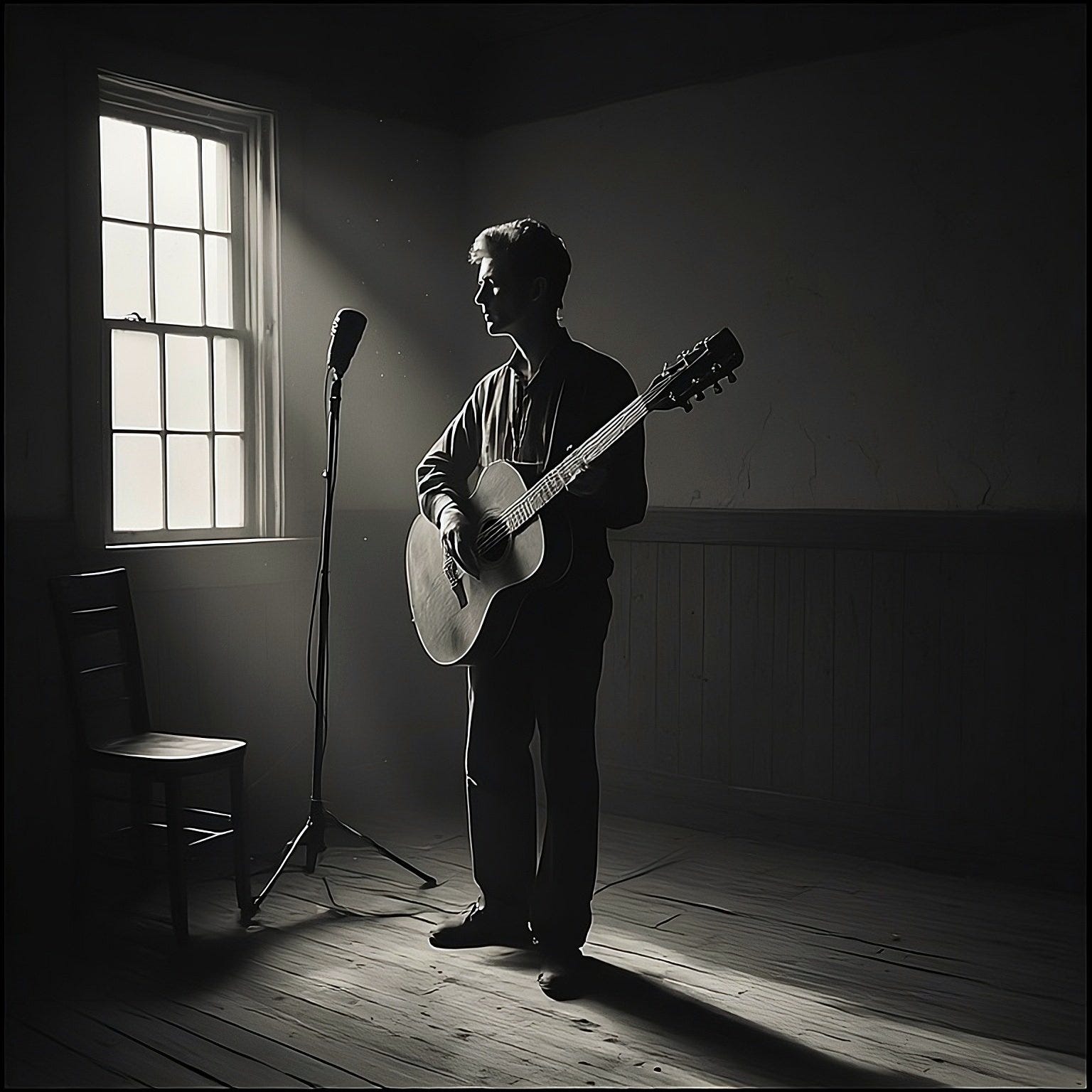
Part Six of the Bowie Series
The Machine Before Tin Machine – Full Album (48:51)
Stream/Download Free MP3
In 1989, David Bowie’s Tin Machine album arrived like a brick through his own stained glass. After a decade of immense commercial success and increasing creative discomfort, he did something quietly radical in that he stepped down. Tin Machine was not “David Bowie featuring a band.” It was a band. No personas. No theatrics. No polished futurism. Just volume, abrasion, and confrontation. Rock stripped back to nerve endings. It confused critics, split fans, and, in retrospect, did exactly what Bowie needed it to do, burn off the residue of twenty years.
Tin Machine was Bowie rejecting the idea that evolution meant forward momentum only. It was a refusal to continue performing himself. Instead, he chose collision, friction, and shared authorship. It was Bowie choosing risk over reassurance.
When I began thinking about adapting Tin Machine, I knew I didn’t want to modernize it, remix it, or drag it forward in time. That would miss his point entirely. Tin Machine was already an act of subtraction. So I asked a different question. If Bowie was going back to rock basics in 1989, what happens if we go even further back? Not to classic rock. Not to punk. Not to glam. Not to Ziggy. But to the taproot of all his personae. To the place where rock music had not yet learned how to stand upright.
1930s Mississippi Delta Blues
This wasn’t about genre cosplay or nostalgia. The blues, especially its earliest recorded forms, is pre-image, pre-myth. It’s music that exists before the spotlight arrives. It’s endurance music. Survival music. Music made in rooms, not studios. Tin Machine was loud because Bowie needed to break something. Delta Blues is quiet because nothing has been protected yet.
The most important choice I made was keeping Bowie’s original vocals exact, well, mostly. His voice anchors the entire project. That late ‘80s Bowie voice carries tension, weariness, clarity, and defiance. By placing it inside a pre-rock environment, the timeline collapses. Bowie becomes both descendant and ancestor. The songs stop sounding like statements and start sounding like discoveries.
What I did was simple, and deliberate. I isolated and preserved Bowie’s vocals from the original stems. I rebuilt the music underneath them as if the 1989 songs were being played in a parallel universe in the 1930s. The electric rock remains, on top of acoustic guitars, resonators, slide, foot stomps, hand claps. No polish. No quantization. No modern safety nets. Bass implied more than declared. Timing loose enough to breathe.
I kept the songs intact. The lyrics, the progressions, the structures, a fusion of two vibes and decades fifty years apart. I didn’t want covers. I wanted the same songs as new but in old skins and bones he might have worn.
This project doesn’t replace Tin Machine. It exists beside it, like an alternate overgarment Bowie might have shed in another life. Bowie was never linear. He didn’t evolve by climbing one line. He evolved by molting in infinite directions. This is Tin Machine without time locking it to one point in space-time. The machine before electricity. Before volume. Before the future arrived. A different yet familiar timeline.
If Bowie taught us anything, it’s that identity is tentative, and the only real failure is staying still.
As he once said:
“I don’t believe in playing safe. I play the way I feel at the moment.”
Tin Machine was unsafe. The Machine Before Tin Machine is hopefully perilous.
I resonate with what you wrote. 'Bowie rejecting the idea that evolution meant forward momentum only' is such a profound analisys of his artistic journey.
I'm looking forward to exploring your fascinating work. As a 44-year Bowie fan, and as one who has been exploring collaborative creativity with LLMs and generative AI since early 2023, I'm genuinely intrigued by what you're creating.
I mainly focus on engaging with ChatGPT, Claude, Suno, and HeyGen to bring my poetry, book projects, and LLM-assisted imagined languages off the page into new forms of audiovisual expression. I enjoy creating avatars, then manifesting the stories and songs they inspire.
I also have a Bowie blog-like project that focuses on his talents and achievements, in part seeking to identify the many genres and subgenres he composed in, integrated, pioneered & enriched. Glad to find you!